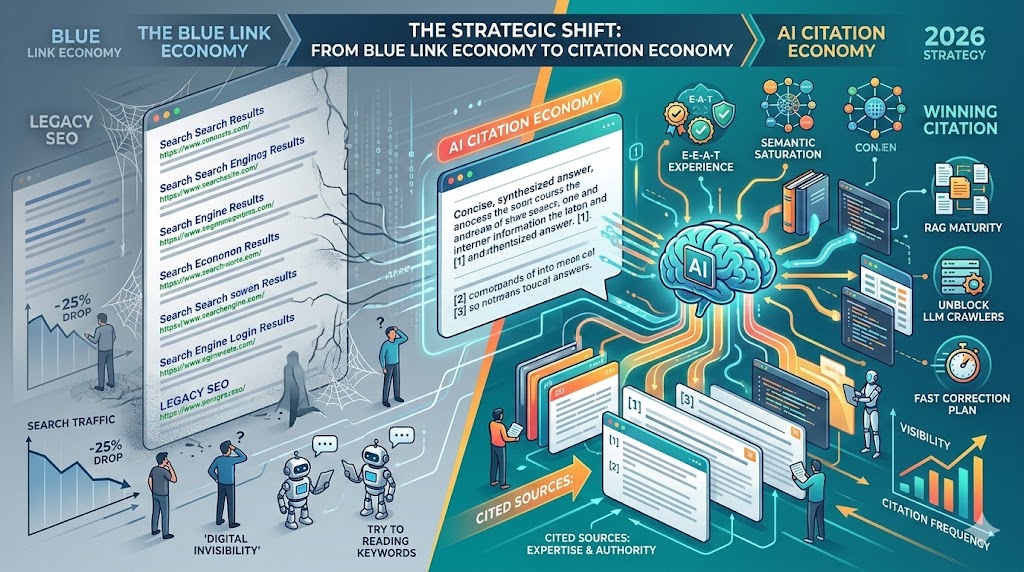
The search landscape is undergoing a massive structural realignment, moving from the “Blue Link Economy” to a “Citation Economy”. As we move through 2026, the traditional SEO playbook is becoming a recipe for digital invisibility.
If you feel like your search traffic is thinning out, you’re not imagining it—Gartner predicts a 25% drop in traditional search volume by the end of this year. The reality is that the “visitor” you’re optimizing for is often an AI summarizer, not a human clicking a link. To stay visible, enterprises need to stop chasing legacy metrics and start building an architecture that AI engines actually want to cite.
Here’s a breakdown of where most organizations are wasting their breath and where the high-value pivots are actually happening.
What’s Wasting Your Time
Many marketing departments are still stuck in “rebranded SEO,” performing tasks that worked ten years ago but fail to trigger modern AI retrieval logic.
- Keyword Density & Exact-Match Phrasing: LLMs don’t “read” keywords; they map relationships between “entities” (people, places, things, or concepts). Over-focusing on keywords often leads to repetitive, “robotic” content that AI engines skip entirely.
- Raw Backlink Volume: While legacy backlinks might help your traditional rank, AI engines prioritize E-E-A-T (Experience, Expertise, Authoritativeness, and Trustworthiness) and verifiable facts over simple domain authority.
- Single-Platform Optimization: Optimizing solely for “Google AI” is a major risk. There is only an 11% overlap in the domains cited by ChatGPT and Perplexity for the same queries, meaning a narrow strategy leaves you invisible to a massive segment of business leaders.
- Prompt Engineering for RAG: Many enterprises waste effort trying to “prompt” their way out of AI hallucinations. Usually, the problem isn’t the prompt; it’s “retrieval failure” caused by poor document chunking and “noisy” data formats.
Where the Real Value Is
The goal is no longer “winning the click,” it’s “winning the citation”. Success now looks like being the definitive, synthesized answer an AI reads aloud.
1. Entity Management & Semantic Clarity
Instead of keyword stuffing, you should be focused on “Semantic Saturation”—deploying high-authority content that uses the specific entity relationships you want the AI to associate with your brand.
- Answer-First Formatting: Don’t “bury the lede”. The first one or two sentences of a page are now the primary signal for an AI deciding whether to cite you as the definitive answer.
- Structured Data (Schema): Schema is the “translator” for AI. Without valid, real-time schema for products, pricing, and FAQs, extraction becomes difficult and your “trust score” with models can drop.
2. Technical Discoverability
You might be inadvertently blocking the bots your customers use.
- Unblock LLM Crawlers: Audit your robots.txt and bot detection systems to ensure agents like GPTBot or PerplexityBot can actually access your data.
- Clean Up “Div-Soup”: AI models struggle with chaotic HTML structures. A poorly structured DOM with skipped heading levels or heavy JavaScript creates a “Retrieval Gap” where even great content gets ignored.
3. RAG Maturity & Data Preparation
If you’re building internal AI tools, focus on how you’re breaking down information.
- Semantic Chunking: Move away from “naive” fixed-size character chunks. Using “Structure-Aware Partitioning” (like Markdown AST) ensures that headers, code blocks, and logical arguments stay together, which can boost accuracy by 40–89%.
4. Monitoring AI Brand Sentiment
Traditional dashboards won’t show you how an AI frames your brand. High-value pivots involve monitoring model-by-model sentiment (comparing ChatGPT vs. Claude, for example) and having a “Fast Correction Plan” to update the specific pages that AI models cite most frequently.
The 2026 Strategic Pivot
| Strategic Goal | Outdated Approach | High-Value Pivot |
| Optimization Goal | Ranking in the top 10 “blue links” | Being the cited source in a synthesized answer |
| Content Structure | Keyword-dense paragraphs | Entity-rich, modular, answer-first formatting |
| Measurement | Tracking CTR and session volume | Monitoring citation frequency and AI sentiment |
| User Intent | Matching terms to landing pages | Solving conversational queries with direct answers |
Inaction is currently the most dangerous waste of time. Enterprises that wait for “perfect metrics” before shifting their strategy are handing market share to competitors who treat their content as a connected, machine-readable network rather than a collection of isolated pages.